



Accelerating Scientific Discovery: An AI-Driven Approach
In the ever-evolving landscape of scientific research, the integration of artificial intelligence (AI) is revolutionizing how discoveries are made and evaluated. This article delves into two innovative automated systems: an AI scientist for generating new research and an automated reviewer for thorough evaluation. Together, they explore the potential of AI in streamlining scientific discovery.
The AI Scientist: A Game Changer in Research
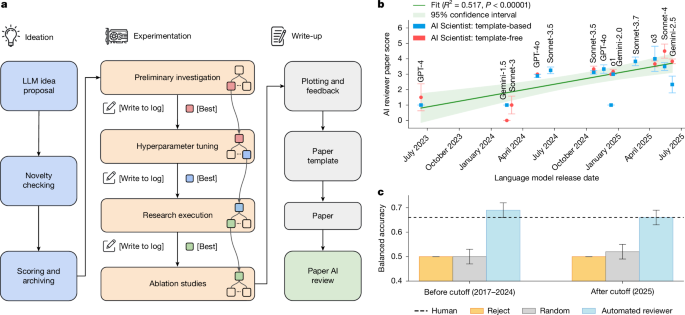
The AI Scientist stands as a pioneering agentic system capable of autonomously conducting machine learning research. It operates in two distinct modes: a template-based system that utilizes human-provided code and a template-free system that encourages more open-ended exploration. The templates serve as a springboard for idea generation, enabling the system to propose variations and extensions of existing research. This iterative approach fosters a growing archive of ideas while leveraging literature checks for novelty, ensuring that the proposed concepts contribute meaningfully to the scientific community.
Innovative Experimentation Phases
The experimentation process executed by the AI Scientist unfolds in three phases: idea generation, experiment execution, and manuscript generation. In the first phase, the system generates structured research proposals including a core hypothesis and experimental plans. Once a promising idea is chosen, it embarks on executing the experimental plan with built-in diagnostic tools for debugging. Each phase is meticulously logged in an experimental journal, allowing the system to draw upon past results to refine future experiments and enhance research quality.
Template-Free Exploration: Breaking Boundaries
Moving beyond fixed starting points, the template-free AI Scientist facilitates a broader range of discoveries. By utilizing diverse AI tools for idea generation and code critique, this version allows for higher-level research proposals that articulate core research problems and hypothesize outcomes. This methodology ensures proposals are novel and relevant, tightly integrated with literature reviews to identify and fill knowledge gaps.
Robust Experiment Management
The structured nature of the experimentation process is enriched by a dedicated progress manager overseeing various stages from feasibility assessments to ablation studies. Each stage requires distinct stopping criteria that guide the system through an organized research cycle. The innovative tree search approach enhances the exploration of various research avenues, equipping the system to manage complexity while swiftly identifying and focusing on the most promising initiatives.
Automated Reviewer: Quality Assurance in Research
An essential component of this innovative methodology is the Automated Reviewer, designed to emulate the peer-review process of prestigious academic conferences. By processing manuscripts and adhering to established guidelines, this AI-driven reviewer generates structured evaluations, complete with numerical scores and assessments of strengths, weaknesses, and ethical considerations. This robust review mechanism enhances the reliability of AI-generated research.
Ethics and Collaboration in AI Research
Ethics plays a pivotal role in the application of AI in scientific research. This study, approved by the University of British Columbia Behavioral Research Ethics Board, underscores transparency and cooperation with conference leadership. By informing peer reviewers about AI-generated submissions, the process maintains a level of integrity and accountability, ensuring that the evolving technologies are applied responsibly.
Conclusion: Embracing the Future of Scientific Discovery
The integration of AI into scientific research is not just a technological advancement; it represents a transformative shift in how research is conducted and evaluated. Through automated systems for research generation and review, we stand on the threshold of a new era in scientific discovery, fostering innovation and collaboration that can drive our understanding of complex problems forward. Embracing these technologies opens new avenues for exploration, ultimately enhancing the quality and impact of scientific contributions.
