



Exploring DLSS 5: A Revolutionary Leap in Gaming Graphics
The transition between console generations has historically brought with it remarkable graphical advancements. While many believed that such significant leaps were a relic of the past, Nvidia’s recently unveiled DLSS 5 suggests otherwise. This cutting-edge technology may represent the graphics enhancement gamers have been longing for. However, it hasn’t come without its fair share of controversy, prompting Nvidia CEO Jensen Huang to swiftly address public concerns.
The Next Generation of DLSS Technology
DLSS—or Deep Learning Super Sampling—has earned its reputation for utilizing artificial intelligence to enhance frame rates and create smoother gameplay. The latest iteration, DLSS 5, goes beyond traditional upscaling and frame generation, introducing a revolutionary “neural rendering” framework that infuses games with breathtaking photorealistic effects. Developed over three years, DLSS 5 aims to breathe life into game characters and environments, creating an immersive experience unlike any other.
First Impressions of DLSS 5 at GTC
During a recent demonstration at Nvidia’s GTC event, the potential of DLSS 5 truly shone. While early versions lack optimization for current hardware, the demos were awe-inspiring. Encountering the enhancements made possible by DLSS 5 left many in attendance—including myself—wondering if this technology could shape the future of gaming graphics.
The Promise of Enhanced Realism
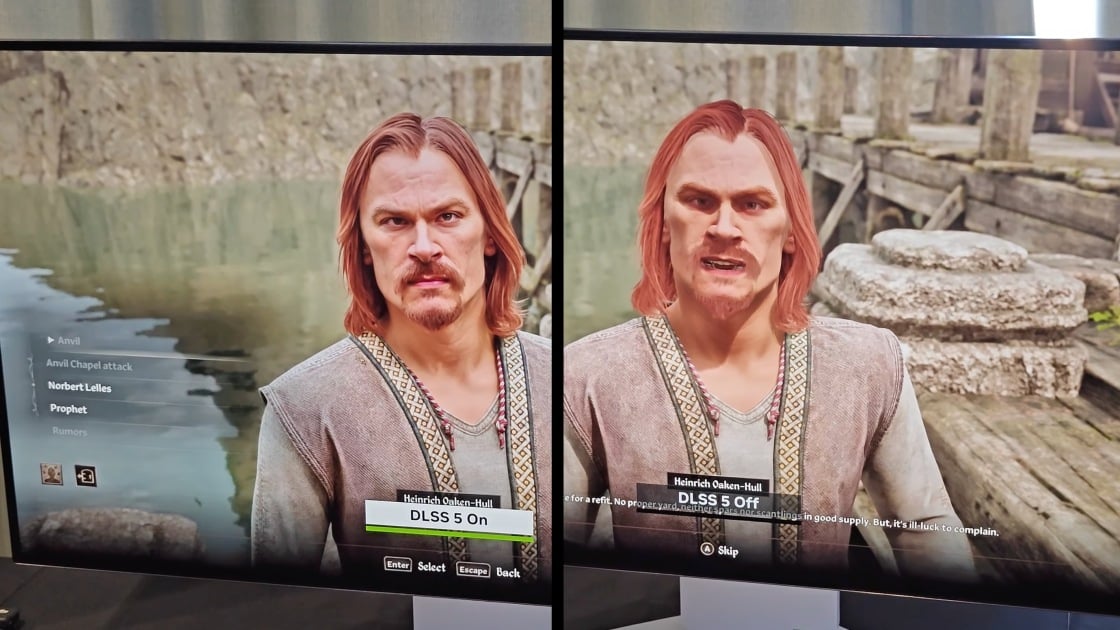
DLSS 5’s neural rendering architecture not only heightens graphical fidelity but also adds intricate details to characters, clothing, and environments, thereby enriching the player’s visual experience. The technology successfully injects additional shadows, textures, and depth, making characters appear startlingly lifelike. However, criticism has arisen regarding the potential for DLSS 5 to act as an overly simplistic image filter—potentially overshadowing the original artistry put forth by game developers.
Redefining Game Graphics
DLSS 5 has proven itself not to be a mere cosmetic upgrade; it transforms game elements into realistic representations. Features that had previously appeared computer-generated now resemble their real-life counterparts. For instance, during a demo of “The Elder Scrolls IV: Oblivion Remastered,” characters evolved from cartoonish figures into realistically depicted beings, enhancing the overall immersion and gameplay experience.
Technical Requirements and Future Prospects
Despite its groundbreaking features, DLSS 5 is still a work in progress. The demonstrations utilized two GeForce RTX 5090 graphics cards, each priced at $1,999, emphasizing the need for significant computational power. Nvidia aims to optimize DLSS 5 for single-GPU setups; however, early tests suggest key adjustments will be necessary to ensure practical application during gaming sessions.
Navigating Challenges and Controversy
With concerns surrounding generative AI and its implications, many gamers approach DLSS 5 with skepticism. The ongoing memory shortages within the PC hardware market further complicate access to the required Nvidia graphics cards. Nevertheless, the realism showcased by DLSS 5 is hard to ignore, indicating a possible shift in gaming graphics that could redefine player experiences. Major developers like Bethesda and Ubisoft have already expressed interest in adopting this new technology, which may alleviate some apprehensions amongst gamers.
In summary, Nvidia’s DLSS 5 promises to elevate the standards of gaming graphics through advanced neural rendering, although its rollout remains to be seen. The benefits of this technology could ultimately reshape the landscape of video gaming, confirming its position as a pioneering force in the industry.
