



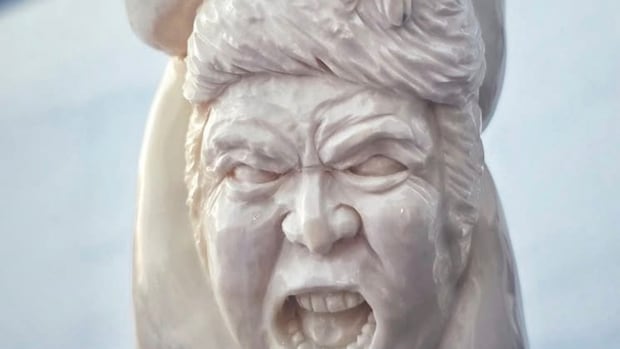
Art and Politics: Kim Kleist-Eriksen’s Powerful Response to Trump’s Greenland Discourse
Greenland’s Kim Kleist-Eriksen transforms the rich traditions of Inuit mythology into captivating art, skillfully carving intricate pieces from sperm whale teeth and walrus tusks. However, his latest creations have taken a political turn, reflecting his responses to contemporary global events.
A Father’s Fury and Artistic Expression
When U.S. President Donald Trump’s geopolitical antics cast a shadow over Greenland, Kleist-Eriksen was deeply moved. The artist recollects how his young daughter expressed fear about Trump’s intentions, prompting him to channel his anger into art. “I was pissed. I wanted to do something with my art,” he expressed in his Nuuk studio. As a Kalaaleq, or Inuk, from Sisimiut, he felt a strong responsibility to respond to the perceived threat to his homeland.
The Tupilak: A Symbol of Resistance
In a surge of artistic resolve, he crafted a tupilak—a vengeful spirit from Greenlandic folklore. This time, he reimagined his previous work featuring colonial missionaries, replacing their faces with that of Trump. “All the colonizers who want our land, I’ve created them like that,” he stated, highlighting the enduring legacy of colonialism intertwined with modern political struggles.
A Viral Success and its Implications
This poignant piece resonated widely on social media, amassing thousands of views and selling within minutes. Kleist-Eriksen’s “revenge” art not only reflects his personal indignation but also aligns with the sentiments of many Greenlanders. As Trump’s interest in Greenland grew, so too did international curiosity about the island, providing a unique platform for promoting Greenlandic culture and voices.
The Economic Impact of the ‘Trump Effect’
The so-called “Trump effect” has invigorated Greenland’s tourism sector, drawing attention from potential travelers eager to explore the region. While initial apprehensions arose from Trump’s controversial comments, the subsequent clarification that he had no intent for military takeover has rekindled interest. Casper Frank Møller, co-founder of the Nuuk-based tour company Raw Arctic, noted a significant surge in inquiries, with expectations for even greater growth in the coming years.
Tourism as a Means of Cultural Exchange
Greenland’s government aims to harness this opportunity by promoting sustainable tourism that fosters genuine cultural engagement rather than sheer volume. Direct flights and enhanced infrastructure are making the territory more accessible. Møller emphasizes, “What has opened up is the possibility of Greenland really becoming part of the international economy,” a vision supported by recent developments such as a new airport in Nuuk.
Future Opportunities and Global Partnerships
Kleist-Eriksen is poised to showcase his work internationally, with an upcoming exhibition featuring his piece, Erlaveersiniooq, at the National Gallery of Canada. This opportunity reflects a growing recognition of Greenlandic artists and their contributions to global culture. As Greenland navigates its complex identity, the potential for partnerships with Canada and the U.S. could lead to valuable cultural exchanges and economic development.
Conclusion: Embracing Change in a Dynamic Landscape
The evolving political landscape, coupled with the growing international interest in Greenland, presents both challenges and opportunities. As voices like Kleist-Eriksen’s rise, they underscore the resilience and richness of Greenlandic culture. “Greenland is not for sale, but we are open for exploring,” encapsulates the sentiments of many as they seek to define their narrative in an unpredictable world.
