



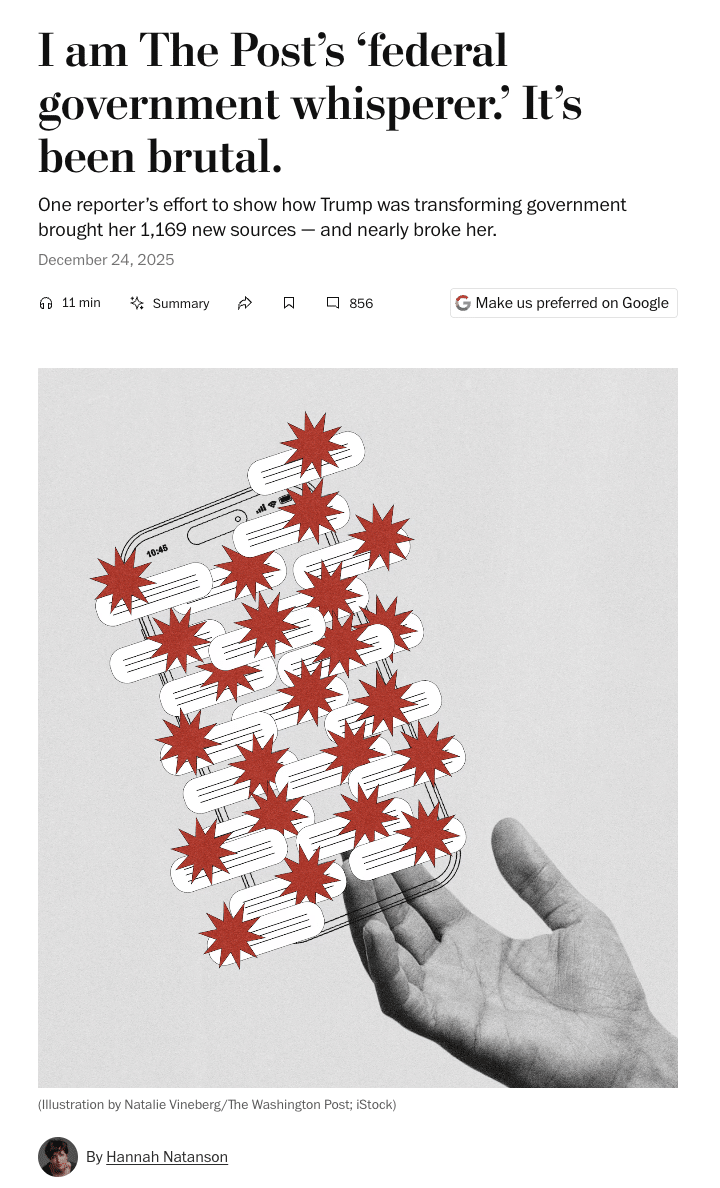
Insights on the Legal Challenges Faced by WaPo Reporter Hannah Natanson
Last week marked a significant moment in journalism as Washington Post reporter Hannah Natanson faced legal challenges while attempting to regain possession of her devices. The situation raised important questions about journalistic protections and the boundaries of investigative journalism.
Security Measures and Their Efficacy
Two key aspects of reporting emerged regarding Natanson’s case. Runa Sundvik highlighted the security features Natanson employed to protect her sources, detailing which methods were effective and which ultimately fell short. Meanwhile, reporting from 404 Media revealed that the FBI struggled to access Natanson’s personal phone, which she had kept in lockdown mode. Instead, they resorted to her work laptop to retrieve her Signal messages.
The Impact of Disclosed Security Practices
Concerns surrounding Natanson’s approach to source protection were validated when it was revealed that her strategies might have inadvertently led to vulnerabilities. In a past article, she shared the lengths she went to safeguard her sources’ anonymity, including using encrypted drives and private browsing tools. Unfortunately, these measures proved insufficient when law enforcement intervened three weeks later, seizing her phone and encrypted drive, as well as her logged-in Slack account.
Legal Oversights and Ethical Implications
In a separate yet crucial dimension of the case, Charlie Savage reported on the absence of mention regarding the Privacy Protection Act (PPA) in the FBI’s affidavit. This 1980 law is designed to restrict the search and seizure of journalistic materials unless the reporter is suspected of certain crimes. Such an omission raises ethical questions about the conduct of Assistant U.S. Attorney Gordon Kromberg, who has a history in cases involving national security and journalism.
Concerns Over Targeted Evidence Collection
Natanson’s case has sparked further scrutiny regarding the FBI’s methods. The agency’s efforts to seize her Garmin device are particularly troubling; the device was not relevant to her communications with the individual currently under investigation. This raises questions about the extent of the FBI’s actions and the justification behind such broad-based seizures.
Unjustified Data Preservation Actions
Furthermore, the FBI’s approach to preserving Natanson’s Signal conversations highlighted an overreach. By making copies of all conversations containing messages post-October 1, they preserved a vast amount of data exceeding their initial probable cause claim. This includes numerous past stories unrelated to the current investigation, thus violating the guidelines of the PPA.
The Broader Implications for Journalism
These developments reflect ongoing tensions between national security and journalistic freedom. The lack of communication between the FBI and the magistrate judge concerning the seizure of reporting materials poses a significant threat to the integrity of journalistic practices. As legal battles continue to unfold, the necessity for clear boundaries protecting journalists becomes increasingly vital.
Conclusion: A Call for Stronger Protections
The case of Hannah Natanson underscores the vulnerabilities facing investigative journalists today. With the intersection of law enforcement and media becoming more complex, it is crucial that protections such as the Privacy Protection Act are upheld. The implications of overreaching legal actions can jeopardize not only individual journalists but also the fundamental principles of a free press.
